


Smoke Testing Sewer Lines Explained
- thetrenchlessguys
- 2 days ago
- 6 min read
A sewer problem does not always show up as a backup. Sometimes it starts as a sewer odor in a basement, stormwater getting into a sanitary line, or a hidden connection that should not be there in the first place. That is where smoke testing sewer lines becomes one of the most efficient diagnostic tools available. It gives property owners, facility managers, contractors, and municipalities a fast way to track down defects that are otherwise hard to find from the surface.
What smoke testing sewer lines actually does
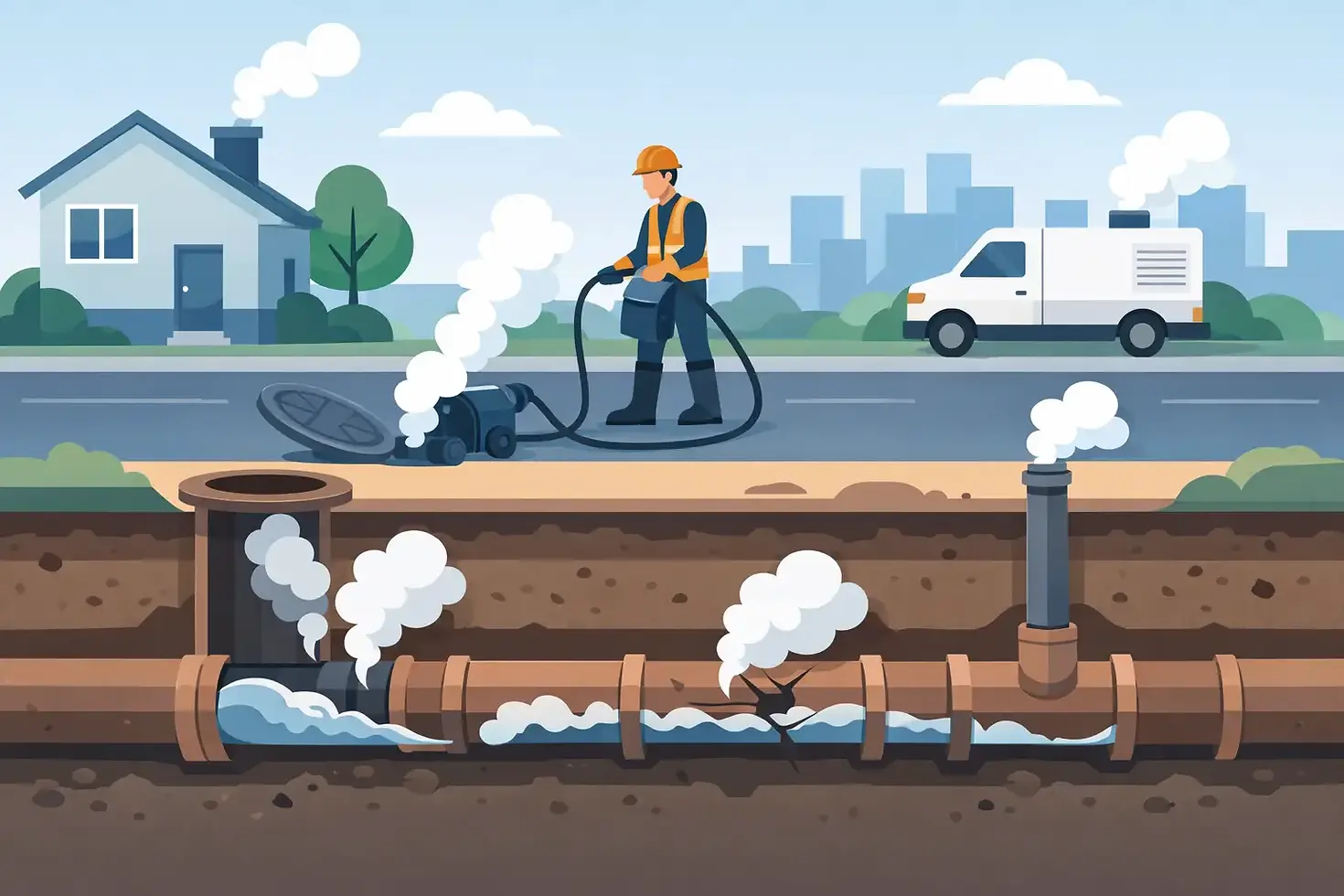
Smoke testing is a controlled inspection process that pushes non-toxic, non-staining smoke through a sewer system. As the smoke moves through the line, it escapes anywhere the system is not properly sealed. That might include cracks, broken pipe joints, disconnected laterals, failing cleanout caps, illegal stormwater connections, or openings that allow sewer gas to enter a structure.
The goal is not to test water flow or pipe grade. It is to expose pathways where air, gas, or unwanted inflow can move in or out of the system. In practical terms, that makes smoke testing especially useful when the issue is odor, infiltration, inflow, or uncertainty about where a private or public sewer line is communicating with surrounding structures or drainage features.
For older neighborhoods, commercial sites with multiple tie-ins, and municipal systems with aging infrastructure, this can save a great deal of time. Instead of guessing where a defect might be, technicians can identify the exact location where smoke appears and narrow the repair scope quickly.
When smoke testing sewer lines makes sense
Not every sewer issue calls for smoke testing first. If a line is collapsed, badly obstructed, or full of heavy debris, CCTV inspection and cleaning may be the better starting point. But there are situations where smoke testing is the right tool early in the process.
A common example is persistent sewer odor inside a home or commercial building. If traps are full and fixtures appear normal, smoke testing can help reveal a dry floor drain, a broken vent, or a cracked section of line that is allowing gas to move where it should not. It is also valuable when a municipality needs to locate stormwater inflow sources that are overloading a sanitary sewer during wet weather.
Property owners with unexplained drainage issues may also benefit from testing if there is concern about cross-connections between downspouts, foundation drains, yard drains, or sanitary lines. In commercial and multi-unit settings, where underground systems are more complex, smoke testing can expose problems that are difficult to isolate from fixture-level symptoms alone.
How the process works on site
The test itself is straightforward, but doing it correctly takes planning and experience. Technicians isolate the section of sewer line to be tested, then introduce a manufactured smoke into the system using specialized equipment. Airflow carries the smoke through the pipes and connected openings.
If the sewer line is sound and properly connected, the smoke should travel only through intended venting points. If there is a defect, smoke will show up at the surface, around structures, from storm drains, from uncapped cleanouts, or inside a building where it should not appear.
Occupants are typically notified in advance because smoke may be visible around roof vents or near plumbing fixtures. The smoke used for this work is designed for sewer testing and is non-toxic, but it can still be alarming if no one expects it. Preparation matters, especially in occupied residential neighborhoods, apartment buildings, retail sites, schools, or municipal districts.
A proper crew also documents where smoke is observed, what the likely defect represents, and whether follow-up inspection is needed. In many cases, smoke testing works best as part of a broader diagnostic approach rather than a standalone answer.
What smoke can reveal and what it cannot
Smoke testing is very good at showing that there is an opening. It is not always the best method for telling you the full structural condition of the pipe. That distinction matters.
For example, smoke may emerge from a yard and indicate a broken lateral, but a camera inspection is often needed to confirm whether the issue is a cracked joint, root intrusion, separation, or a complete break. The smoke points you toward the defect. CCTV usually tells you how severe it is and what repair method makes the most sense.
The same applies to illegal connections. Smoke may show that a downspout or area drain is tied into a sanitary sewer, but additional tracing may be needed to map the exact route and determine the right correction. So while smoke testing is efficient, it is most effective when paired with a team that can move from detection to diagnosis to repair.
Why this matters for property owners and facility managers
Hidden sewer defects are expensive mainly because they tend to stay hidden until they create bigger problems. A small opening in a line can allow groundwater in, increase system load, contribute to backups, or release sewer gas into occupied spaces. On commercial properties, that can affect operations, tenant satisfaction, and maintenance budgets. On municipal systems, it can strain capacity and treatment costs. For homeowners, it can turn a minor issue into a major excavation job if it goes unaddressed for too long.
Smoke testing helps shorten that timeline. It can identify issues before they lead to repeated service calls or unnecessary digging. For a facility manager trying to isolate an odor complaint in a large building, that speed matters. For a homeowner trying to avoid tearing up a driveway without a clear reason, it matters just as much.
There is also a cost-control benefit. When the defect location is known, repairs can be more targeted. That is especially important when trenchless options are on the table. If a problem can be pinpointed and the pipe is otherwise a good candidate, rehabilitation methods like lining or localized repair may be possible with far less disruption than full excavation.
Smoke testing and trenchless repair planning
This is where diagnostic work becomes more than just inspection. It becomes the foundation for the right repair strategy.
When smoke testing identifies likely breaks, leaks, or cross-connections, technicians can combine that information with CCTV data to determine whether a pipe should be cleaned, lined, coated, spot repaired, or replaced. In some cases, the issue is not the main itself but a lateral connection, venting defect, or unauthorized tie-in. That changes the scope completely.
For property owners in Akron and across North Central Ohio, the value is practical. You want to know what is wrong, where it is, and whether it can be fixed without tearing apart pavement, landscaping, or occupied spaces. That is why experienced trenchless contractors use smoke testing as one part of a larger, minimally invasive process.
Common concerns about sewer smoke testing
The first concern people usually have is safety. The smoke used in sewer testing is made for this purpose and is non-toxic and non-staining when used properly. It is visible by design because technicians need to see where it escapes. That said, anyone with respiratory sensitivity may still want advance notice, and pets or occupants should be considered during planning.
Another concern is whether smoke inside a building always means a major sewer failure. Not necessarily. Sometimes the cause is as simple as a dry trap in a floor drain or an unused fixture. Other times it points to a venting defect, a loose fitting, or a more significant break. This is one of those it-depends situations where the observation matters, but the follow-up diagnosis matters just as much.
People also ask whether smoke testing is messy or disruptive. Compared with exploratory digging, it is relatively clean and efficient. The real disruption usually comes only if the test confirms a condition that needs repair. Even then, finding the problem early often reduces total disruption because the repair can be planned more precisely.
Choosing the right team for smoke testing sewer lines
The equipment matters, but the interpretation matters more. A crew needs to understand sewer system layout, venting behavior, inflow and infiltration patterns, and how test results connect to repair decisions. Without that experience, smoke observations can be misread or left unresolved.
That is why property owners should look for a contractor that can do more than run a test. The right provider should be able to inspect with camera equipment, explain what the smoke findings mean, and recommend the least disruptive repair option based on actual pipe condition. For many sites, that means combining smoke testing with trenchless planning instead of treating it as a one-off service call.
At The Trenchless Guys Akron, that kind of integrated approach is the point. Diagnostic accuracy is what makes minimally invasive repair possible.
Sewer issues are rarely convenient, but they do not have to stay mysterious. When smoke testing is used at the right time and backed by experienced inspection and repair capabilities, it gives you something every property decision-maker wants - a clear problem, a clear location, and a smarter next step.


Comments