


Trenchless Pipe Replacement Near Me
- thetrenchlessguys
- 16 hours ago
- 6 min read
A sewer line usually fails at the worst possible time - after backups start, after the yard is saturated, or right when a business cannot afford disruption. If you are searching for trenchless pipe replacement near me, you are probably not looking for theory. You want to know whether your line can be fixed without tearing up the driveway, landscaping, parking lot, or floor slab.
That is exactly where trenchless methods make sense. Instead of opening a long trench across the property, the work is typically done through existing access points or small excavation areas. For homeowners, that can mean protecting a finished yard. For commercial properties and municipalities, it can mean keeping operations moving while the underground problem gets handled with far less surface damage.
What trenchless pipe replacement near me really means
Most people use the phrase to describe any sewer or underground pipe repair that avoids major digging. In practice, there are a few different methods, and the right one depends on the pipe material, the severity of the damage, the pipe diameter, and site access.
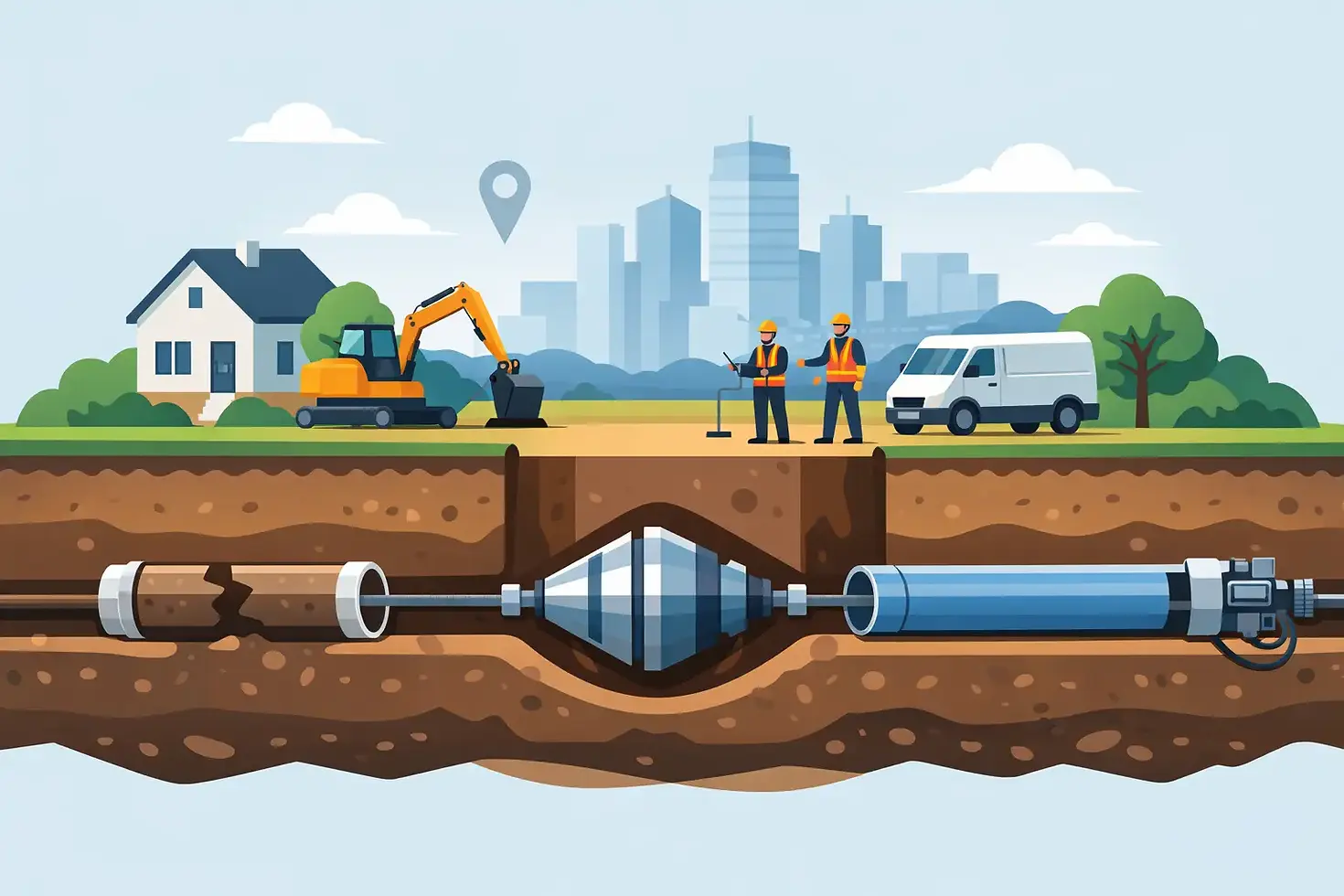
In some cases, the damaged pipe can be rehabilitated from the inside with cured-in-place pipe lining, often called CIPP. In others, the old line is too badly broken, offset, or collapsed for lining, and pipe bursting is the better choice. Pipe bursting replaces the existing line by pulling a new pipe through while fracturing the old one outward.
That distinction matters because not every "no-dig" solution is a full replacement. Some are structural repairs. Some are true replacements. A qualified contractor should inspect the line first, explain what is possible, and tell you where trenchless stops being the best option.
How the process usually starts
No dependable trenchless contractor should recommend replacement based on symptoms alone. Backups, odors, slow drains, and wet patches in the yard can all point to a sewer problem, but they do not tell the full story.
The first step is usually a CCTV sewer inspection. A camera is sent through the line to identify cracks, root intrusion, offsets, corrosion, grease buildup, or full collapse. For many properties, cleaning the pipe with hydro jetting or another clearing method happens before the final inspection so the condition of the host pipe can be seen clearly.
This inspection stage does two things. It confirms whether trenchless repair is possible, and it prevents overselling. A line with isolated grease buildup may need cleaning, not replacement. A line with heavy root intrusion and broken sections may need rehabilitation now before it becomes an emergency later.
When trenchless replacement is the better choice
Trenchless work is not just about avoiding a mess. It is often the smarter long-term decision when the damaged line runs beneath expensive or hard-to-repair surfaces.
If your sewer passes under a driveway, garage floor, retaining wall, mature trees, patio, roadway, or parking area, traditional excavation can add major restoration costs after the plumbing work is done. That is why trenchless replacement is often attractive even when the direct pipe repair cost is similar. The bigger savings may come from avoiding concrete replacement, landscape reconstruction, business interruption, or tenant complaints.
This is especially relevant for commercial sites, apartment properties, schools, and municipal systems. Digging across active facilities can create access issues, safety concerns, and downtime that cost far more than the pipe work itself.
Two common methods used for trenchless sewer work
CIPP lining
CIPP lining creates a new pipe within the existing one. A resin-saturated liner is inserted into the damaged pipe, then cured in place to form a hard, jointless interior wall. This method works well when the original pipe still has enough structural integrity to host the liner.
The biggest advantage is minimal disruption. There is usually little digging, and the finished liner resists root intrusion because there are no joints for roots to force apart. It can also improve flow by smoothing rough interior surfaces.
The trade-off is that lining slightly reduces the internal diameter of the pipe, and it is not ideal for every collapse or severe offset. If the original line has lost shape or has major missing sections, pipe bursting may be the better solution.
Pipe bursting
Pipe bursting is a true replacement method. A bursting head is pulled through the old pipe, breaking it apart while drawing in a new high-density pipe behind it. This is often used when the existing line is too damaged for lining or when a full new pipe is the preferred outcome.
It still avoids the long trench associated with traditional replacement, but it does require the right site conditions and access points. It is highly effective for many buried sewer lines, though nearby utilities, depth, soil conditions, and bends in the line all need to be evaluated before the method is approved.
What affects the cost
People often ask for a price before the line is inspected, but trenchless pricing depends on several variables. Pipe depth, length, diameter, access, soil conditions, number of connections, cleaning needs, and restoration requirements all matter.
A short residential sewer lateral with good access is very different from a long commercial run under pavement. Likewise, a line that only needs lining is different from one that requires point repairs, root removal, or reinstatement of multiple branch connections.
The useful way to compare costs is not just trenchless versus excavation. It is total project cost. Traditional digging can look cheaper at first glance until the driveway, sidewalk, landscape, or slab repair is added back in. On many properties, trenchless methods become competitive precisely because they reduce those secondary expenses.
Why local expertise matters in North Central Ohio
If you are typing "trenchless pipe replacement near me," you are not just looking for any contractor with equipment. Local experience matters because underground conditions, seasonal weather, aging infrastructure, and municipal requirements vary from market to market.
In Akron and surrounding North Central Ohio communities, many properties have older sewer systems, mixed pipe materials, and access challenges tied to established neighborhoods and developed commercial sites. Freeze-thaw cycles, root intrusion, corrosion, and long-deferred maintenance can all complicate a project.
A contractor who understands the region can usually assess those issues faster and recommend the method that fits the site, not just the method they prefer to sell. That is one reason specialized trenchless companies tend to outperform generalists on these projects. They have the inspection tools, cleaning equipment, rehabilitation capabilities, and field judgment to match the repair to the actual pipe condition.
Questions to ask before hiring
Not every sewer company is built around trenchless work. Some offer it occasionally. Others specialize in it and have the equipment and experience to handle a wider range of conditions.
Ask whether a camera inspection is included, whether they perform both lining and pipe bursting, and how they determine which method is appropriate. You should also ask what prep work may be needed, whether branch lines can be reinstated, how bypass flow is handled if required, and what kind of warranty or post-repair verification is provided.
For commercial and municipal customers, project coordination matters too. You want to know how access will be managed, whether the work can be phased, and how the crew plans to minimize disruption to operations.
Signs you should not wait
Some sewer problems can be scheduled. Others get expensive quickly. If multiple drains are backing up, sewage odors are persistent, the yard has unexplained wet areas, or the line has a history of recurring root intrusion, waiting usually does not improve the situation.
The same applies if your camera inspection already showed cracks, offsets, corrosion, or partial collapse. A planned trenchless repair is almost always easier to manage than an emergency replacement after a total failure.
For property managers and facility operators, this is often the deciding factor. The cost of reacting late includes not only pipe repair, but also cleanup, service interruption, tenant impact, and potential property damage.
Choosing a solution that fits the pipe, not the sales pitch
The best trenchless outcome starts with an honest diagnosis. Some lines should be cleaned and monitored. Some are strong candidates for CIPP lining. Some need pipe bursting. And a few are damaged badly enough that selective excavation is still the right answer.
That is the practical value of working with a trenchless specialist. You get a recommendation based on inspection data, site conditions, and long-term performance - not a one-size-fits-all answer. Companies like The Trenchless Guys Akron build their reputation on that kind of technical precision because underground repairs only feel cost-effective when they hold up.
If you are weighing options now, focus on the contractor who can show you what is happening inside the line, explain the trade-offs clearly, and solve the problem with the least disruption your property actually allows.



Comments